Blue-and-white porcelain of the Ming and Qing Dynasties
Emperor Yongle-Ming Dynasty, Emperor Yongzheng and Emperor Qianlong-Qing Dynasty (from the upper to the lower) Total auction price: USD21 million (Christie's Hong Kong 2025)
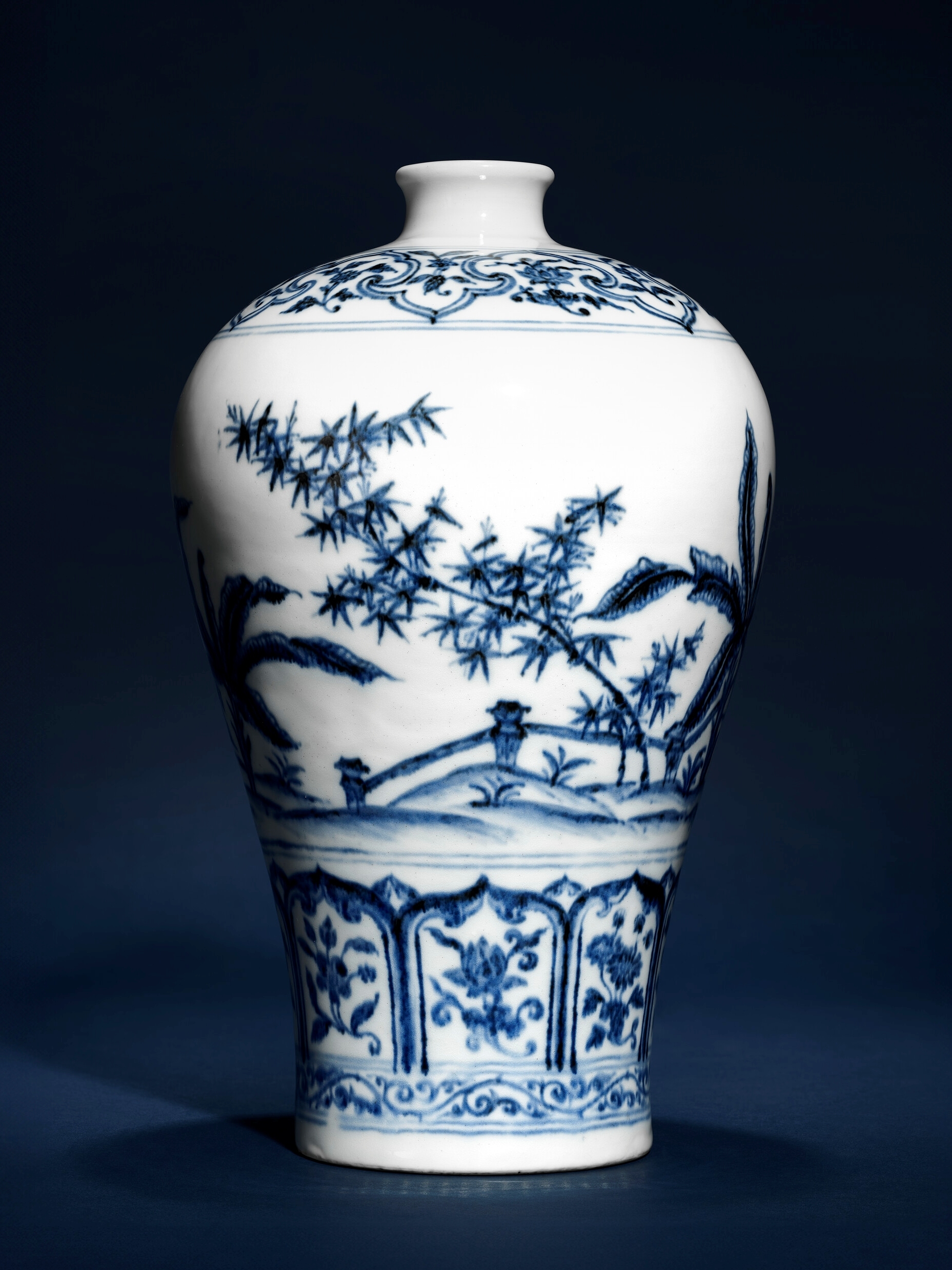
A fine and very rare blue and white ‘bamboo, rock and plantain’ vase, meiping
Yongle period (1403-1425)
Height: 35 cm
Estimate: HK$50,000,000 - 80,000,000 (US$6.5 - 10 million)
Few Chinese ceramics are as iconic as blue-and-white porcelain, and those produced during the Yongle and Xuande (1425-1435) periods of the Ming dynasty are widely regarded as the finest – so much so that, for a time, they were practically synonymous with China itself.
Among blue-and-white porcelains, Yongle-period meiping vases stand out as true classics, cherished not just by collectors but by generations of emperors. Known for their refined craftsmanship and elegant silhouette, they remain highly sought after, often commanding impressive prices at auction. Some notable sales in recent years include:
- Yongle blue and white meiping and a cover | 37.8 cm | Sold: HK$50.52 million, Christie's Hong Kong, 2016
- Yongle blue and white ‘fruit’ meiping | 28 cm | Sold: HK$48.28 million, Sotheby's Hong Kong, 2014
- Yongle blue and white ‘fruit’ meiping | 28.6 cm | Sold: HK$27.66 million, Sotheby's Hong Kong, 2017
- Yongle blue and white ‘fruit’ meiping | 29 cm | Sold: RMB 25.3 million, China Guardian (Beijing), 2020
- Yongle blue and white 'lotus' meiping | 31.4 cm | Sold: HK$24.57 million, Sotheby's Hong Kong, 2022
While Yongle-period meiping vases are already rare on the market, most feature floral or fruit motifs, making this example – decorated with a garden landscape of bamboo, rocks, and plantain – even rarer. Similar examples can be found in the Palace Museum in Beijing and the National Museum of China.x
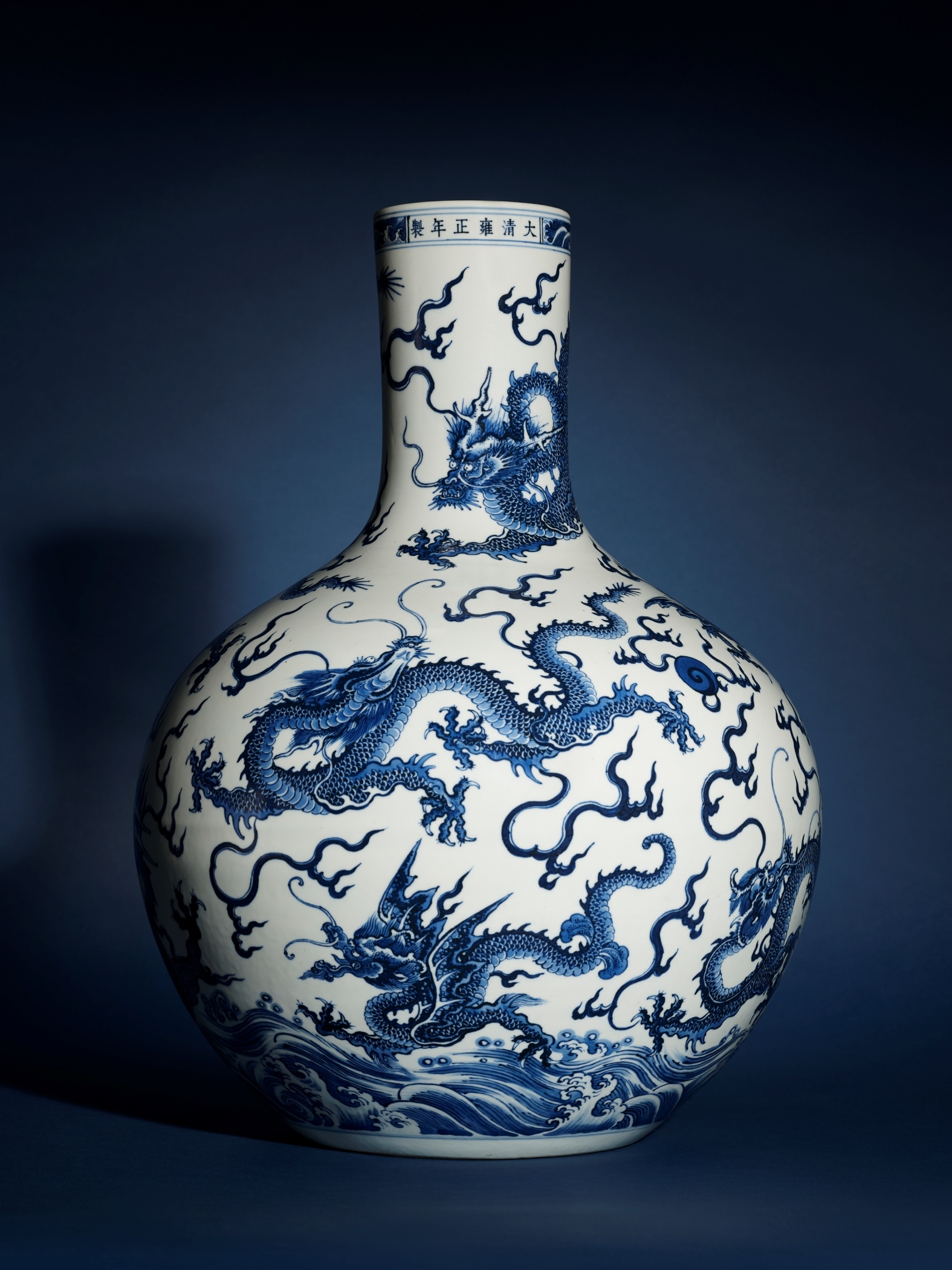
A fine and extremely rare large blue and white ‘dragon’ vase, tianqiuping
Yongzheng six-character mark in underglaze blue in a line and of the period (1723-1735)
Height: 51.5 cm
Estimate Upon Request
Remarks: With a total low estimate exceeding HK$100 million, this lot is expected to fetch in the region of HK$50 million
If the Yongle meiping embodies elegance, this Yongzheng tianqiuping (literally 'celestial sphere vases') is a bold statement of imperial power. Considered one of the most striking forms in Qing imperial porcelain, the tianqiuping is among the rarest shapes produced for the court.
In recent years, two notable dragon-decorated tianqiuping have appeared at auction – both featuring underglaze blue and copper red:
- Yongzheng underglaze-blue and copper-red-decorated ‘dragon’ tianqiuping | 51.5 cm | Sold: RMB 147 million, Poly Auction Beijing, 2019
- Yongzheng underglaze-blue and copper-red-decorated ‘dragon’ tianqiuping | 51 cm | Sold: HK$56.03 million, Christie's Hong Kong, 2023
By contrast, blue-and-white tianqiuping featuring nine dragons are exceedingly rare. This Yongzheng-period example is one of the very few known, with a nearly identical piece housed in the Tianjin Museum.
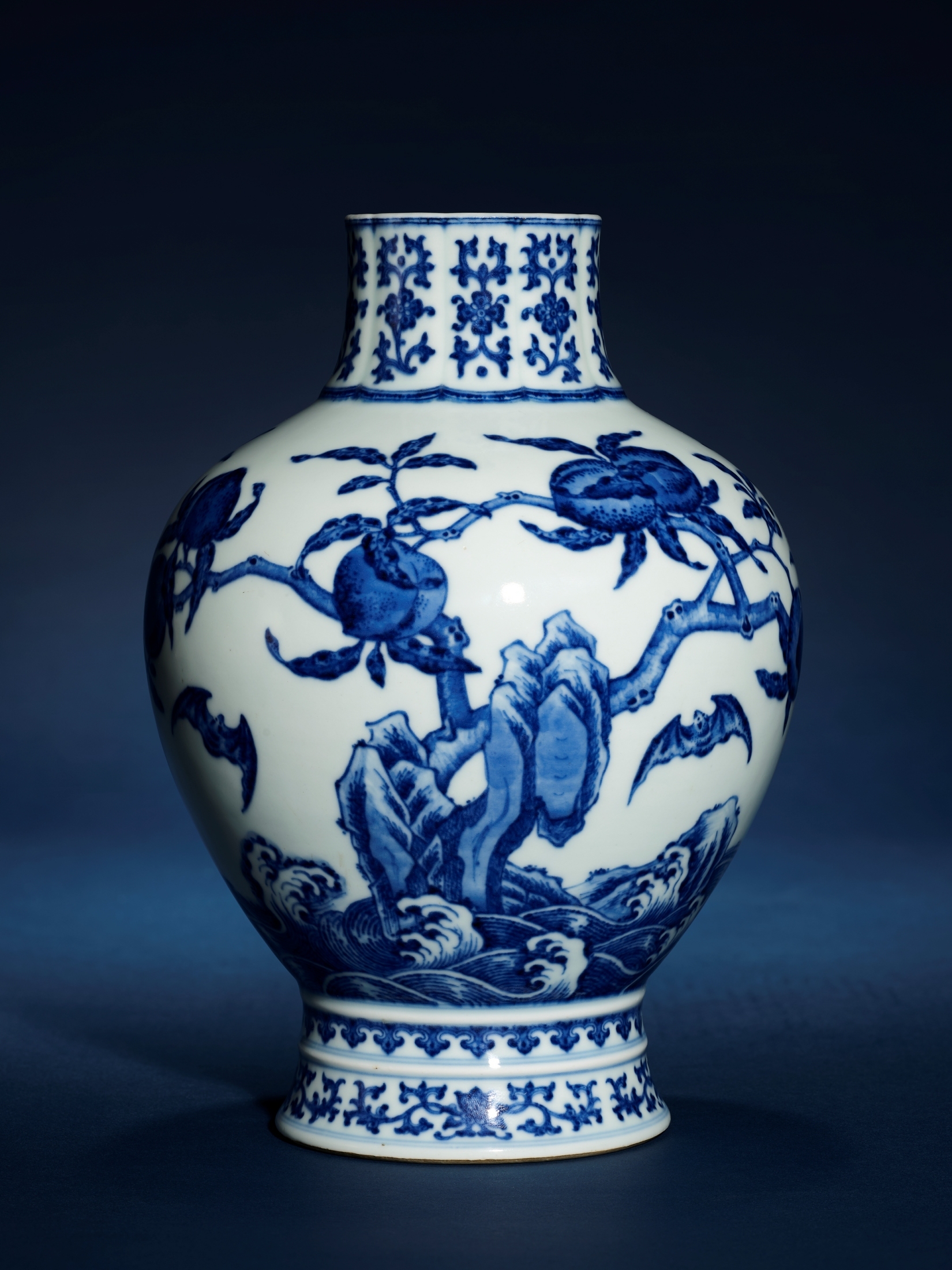
A fine and very rare blue and white ‘peach’ vase
Qianlong six-character seal mark in underglaze blue and of the period (1736-1795)
Height: 25.3 cm
Estimate: HK$3,000,000 - 5,000,000 (US$390,000 - 650,000)
Blending auspicious symbols of longevity and good fortune, this Qianlong blue-and-white 'peach-and-bats' vase demonstrates the height of Qing craftsmanship and deliberate homage to early Ming decorative styles.
Peach motifs were especially popular during the Yongzheng and Qianlong (1736–1795) periods, with Yongzheng-period designs typically featuring eight peaches and Qianlong examples nine.
On this vase, the nine peaches symbolize longevity, while the five bats complement the theme, as their name forms a homophone for the Five Blessings (wufu 五福) – longevity, wealth, health, virtue, and a peaceful death.