1-Jar; 2-The big brush pot; 3-The small one; 4-Imperial seal; 5-Buddha statue
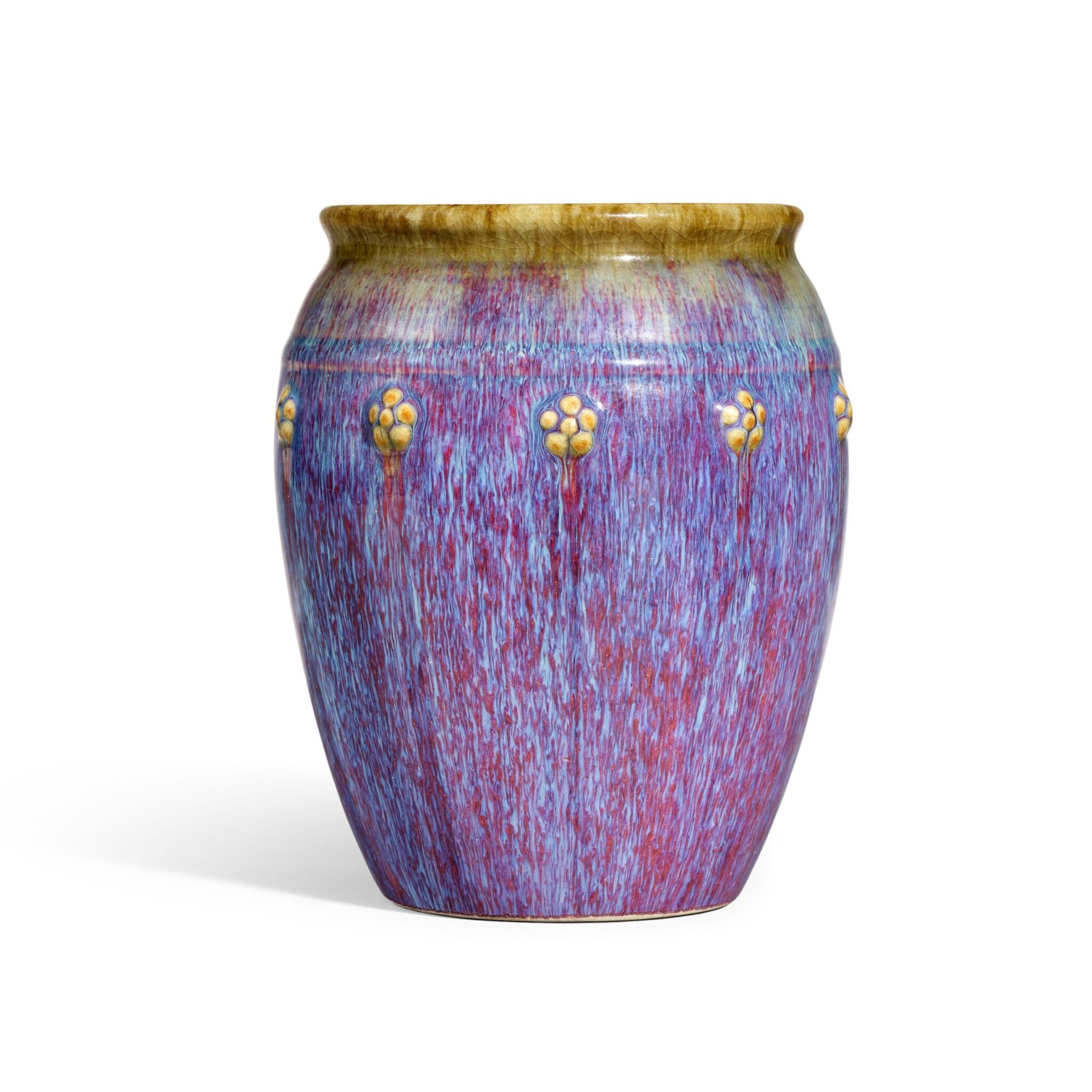
1 - AN EXQUISITE AND RARE FLAMBE-GLAZED JAR
Yongzheng seal mark and of the period
Elegantly proportioned, the ovoid body gently rising to a slightly waisted neck, decorated around the shoulders with a band of raised florettes, covered overall with a vibrant purple glaze suffused with milky lavender streaks, draining to a mushroom tone around the rim, the base in olive-brown glaze.
Characterised by a refined elegance and technical excellence typical of Yongzheng porcelain, jars of this kind are exceptionally rare. Under the discerning eye of the Emperor, who possessed an extensive understanding of the antiquities within the imperial collection, a variety of experimental glazes were created to blend the beauty of renowned historical pieces with a modern aesthetic that appealed to the Emperor's preferences.
The design of this particular vessel is notably distinctive, featuring sharply defined florets positioned beneath a raised horizontal rib and an outwardly flared rim. The way the glaze flows over and around the florets draws inspiration from early Ming 'numbered' Jun narcissus planters adorned with 'drum nail' bosses, similar to one found in the Qing Court collection showcased in the exhibition The Enchanting Splendor of Vases and Planters: A Special Exhibition of Flower Vessels from the Ming and Qing Dynasties at the National Palace Museum, Taipei, 2014, cat. no.I-04.
The reproduction of Song 'Jun' glazes began during the Xuande period in the early 15th century at the Jingdezhen kilns and saw a resurgence under the Yongzheng Emperor, who had a particular affinity for Song wares and commissioned replicas of Jun pieces from the imperial workshops there. The technical skill and innovative spirit of the potters at the imperial kiln are highlighted in the official list from 1735, noted on the Taocheng jishi bei ji [Commemorative Stele on Ceramic Production], inscribed by Tang Ying (1682-1756), the preeminent Superintendent of the imperial kilns. This significant document details at least nine varieties of Jun glazes inspired by ancient examples, five of which were based on Song originals sent from the palace in Beijing to the Jingdezhen kilns. Tang Ying is well-known for his efforts to replicate Song Jun wares, even dispatching his secretary, Wu Yaopu, along with select craftsmen to Junzhou in 1729 to collaborate with local potters in order to acquire the recipe for producing Jun glazes. Qing dynasty Jun-type wares are characterized by a durable body, a trimmed foot coated with a brownish slip, and frequently feature an impressed or incised mark.
Sold for HK$1,655,000 inc. premium - From Bonhams Hong Kong, 27 Nov 2024.
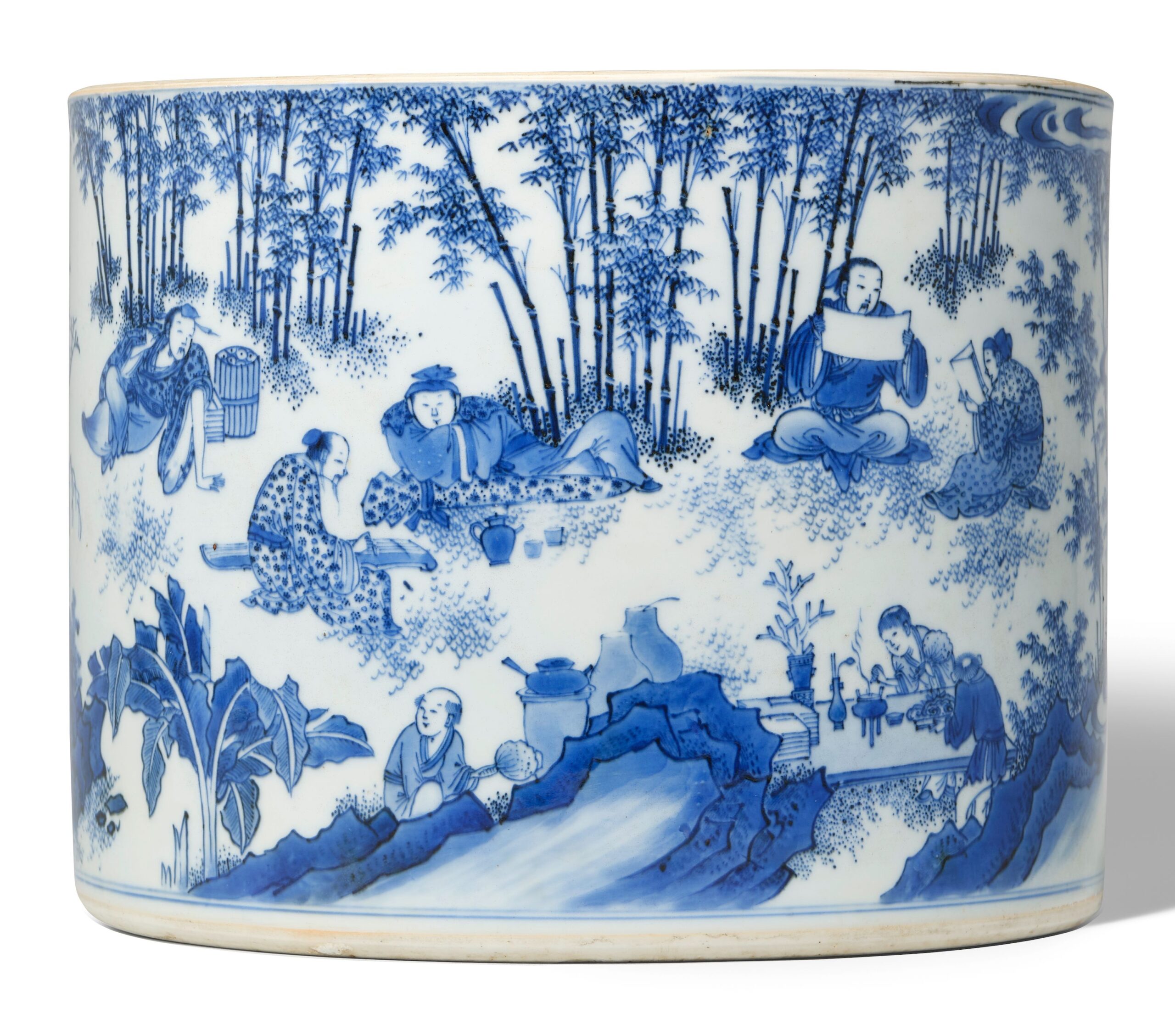
2 - AN IMPORTANT EXTREMELY LARGE BLUE AND WHITE 'SEVEN SAGES OF THE BAMBOO GROVE' BRUSH POT - Chongzhen reign, the Ming Dynasty.
Sturdily potted, the massive brushpot, exquisitely painted around the exterior in vibrant tones of cobalt-blue with a continuous scene of a scholars in various leisurely pursuits amidst a bamboo grove, two scholars sit by their zithers and another rests on a pile of scrolls while a boy attendant fans a stove with tea boiling, two other boy-attendants arrange a table with antiques, books and incense burning instruments while two other scholars sit reciting poetry, on the bridge an elegant scholar before a waterfall gazes back at another scholar carrying a fly-whisk, a boy attendant following with a bundle of scrolls, all amidst a landscape with bamboo, V-tick grass, gnarled rocks and various trees and shrubs.
28.4cm (11 1/4in) wide, 20.8cm (8 1/4in) high.
Sold for HK$3,560,000 inc. premium - From Bonhams Hong Kong, 27 Nov 2024.
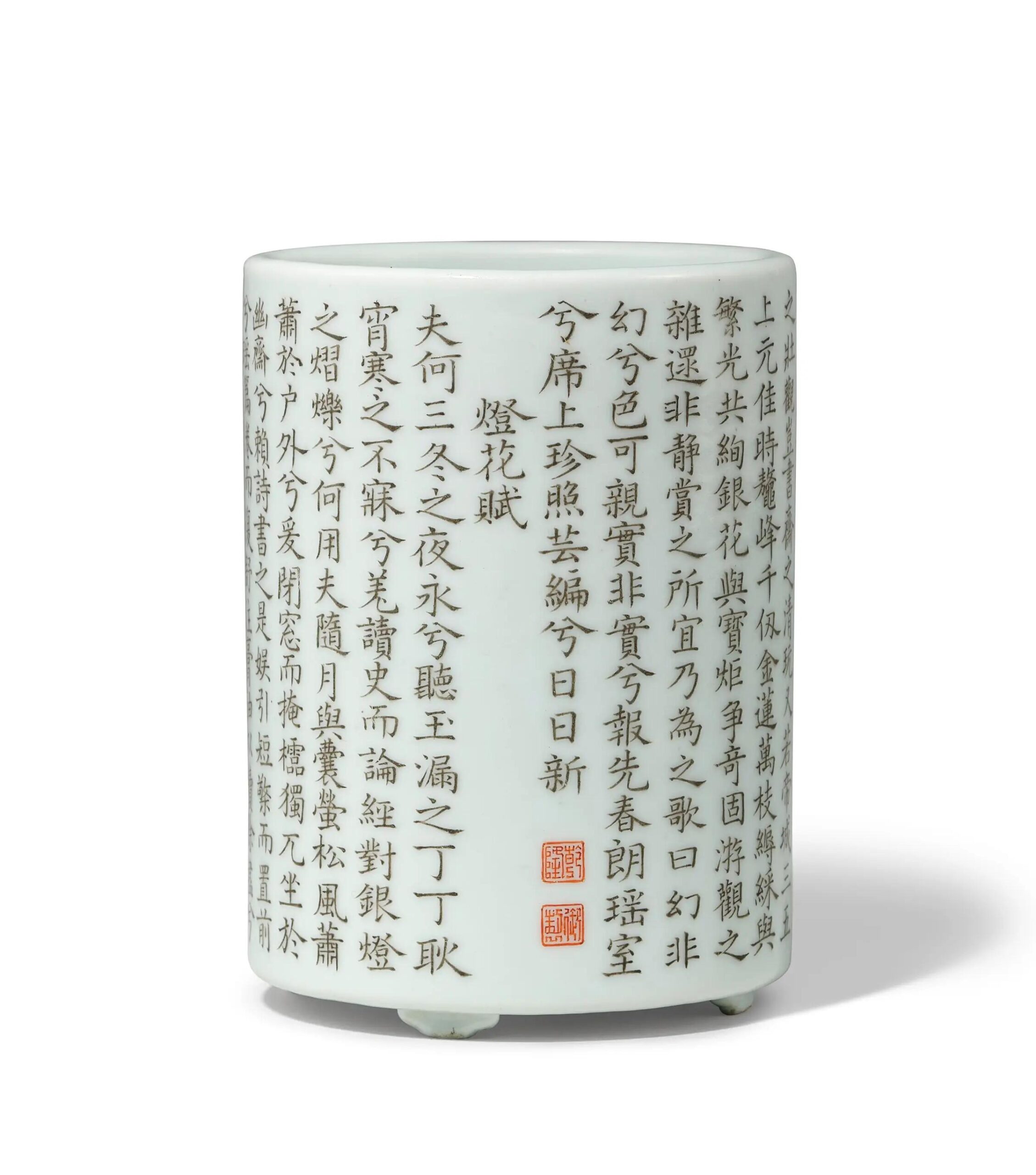
3 - AN EXCEPTIONALLY RARE IMPERIAL ENAMELLED 'QIANLONG POEM' BRUSH POT
Qianlong Yuzhi seal marks and of the period
Finely potted of cylindrical form with tall straight sides supported on four bracket feet, the exterior meticulously enamelled in dark grey with a 28 columns of fu-rhapsody in kaishu calligraphy against an ivory white, two small seals in red. 10.1cm (4in) high.
Sold for HK$4,449,000 inc. premium - From Bonhams Hong Kong, 27 Nov 2024.
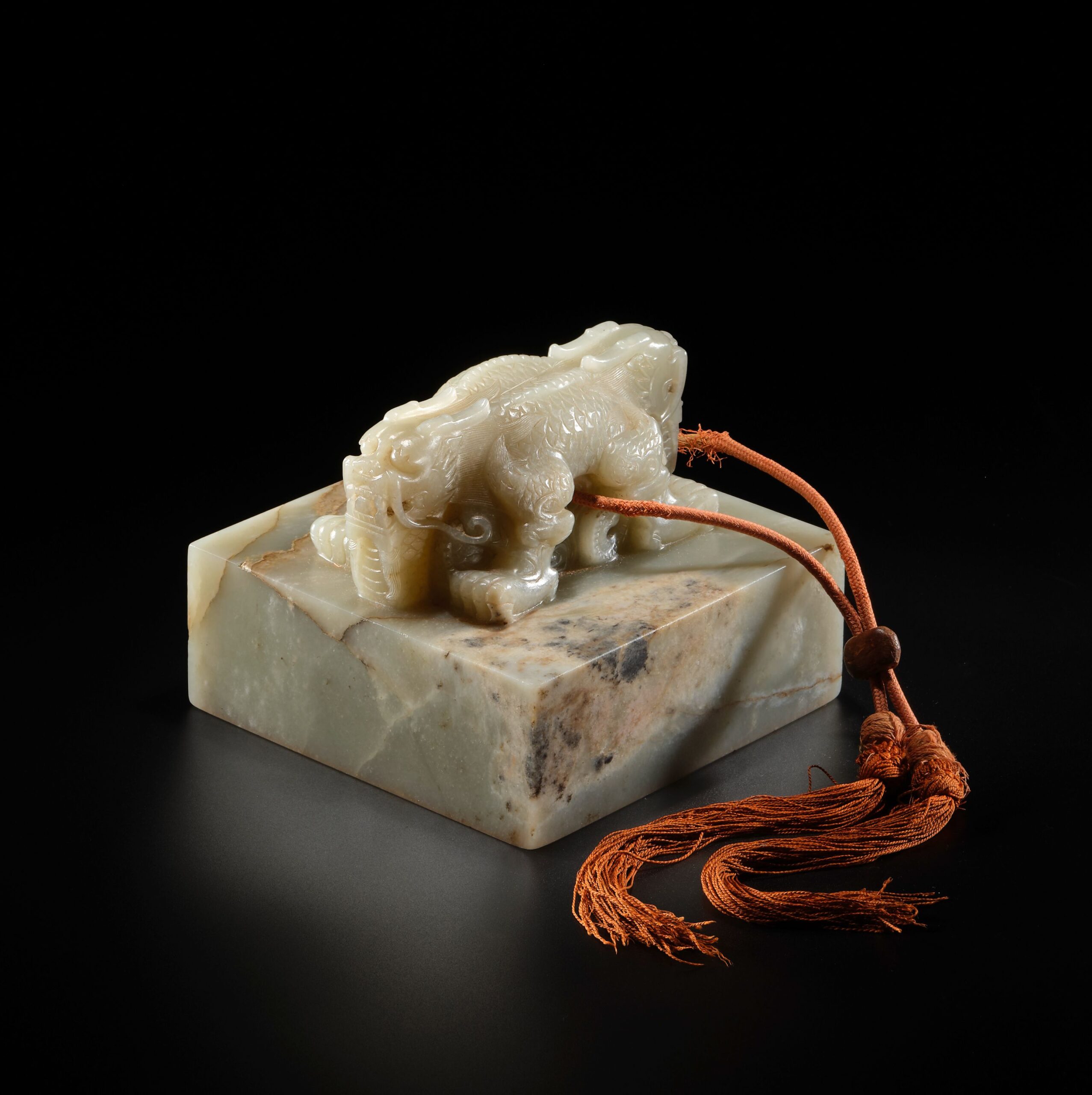
4 - AN IMPORTANT IMPERIAL PALE GREEN JADE 'NANHAIZI JIUXINGGONG BAO' SEAL of Emperor Qianlong
This extremely important lot exemplifies the extraordinary craftsmanship and technical expertise that flourished in the jade workshops during the Qianlong reign. The substantial size of the jade stone highlights the significance of this piece, particularly considering the scarcity of jade resources during that period, especially prior to the Qianlong Emperor's conquest of the Dzungar Khanate between 1755 and 1759, which became a major source of jade. The jade carver masterfully showcases his artistry through intricate sculptural details, with meticulous attention given to the dragon's facial and bodily features. The remarkably precise carved characters on the seal face further reflect the carver's skill, all finished with a high-quality, smooth polish that enhances the overall power and beauty of the piece. This combination of size, detail, and finish not only underscores the technical virtuosity of the period but also elevates the piece to a status of remarkable significance within the realm of jade craftsmanship.
Nanhaizi (南海子), also known as Nanyuan (南苑), is located at the forefront of the Yongding River in the southern suburbs of Beijing. It was once the largest wetland in the Beijing region. Historically, this area served as a royal hunting ground for the Liao, Jin, Yuan, Ming, and Qing dynasties, as well as a royal garden during the Yuan, Ming, and Qing dynasties. In the Qing period, it became an important site for emperors to handle state affairs and hold grand ceremonies,
pioneering the concept of emperors governing from gardens during the Qing dynasty.A painting depicting the hunting scenes of the Qianlong Emperor in Nanyuan, from the collection at the Palace Museum in Beijing.
Auction Estimate: HK$6-8,000,000 - From Bonhams Hong Kong, 2024
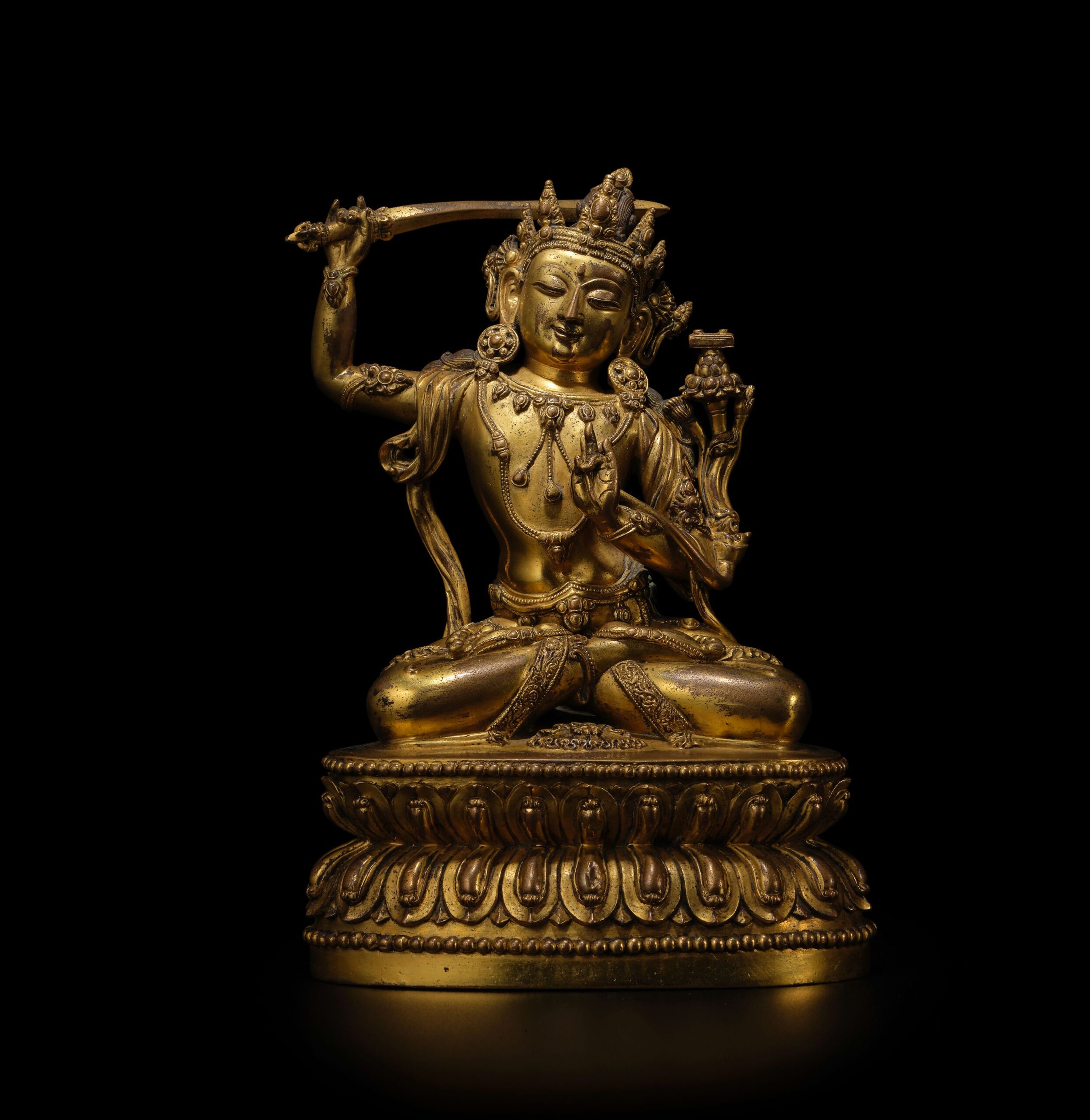
5 - AN EXCEPTIONALLY RARE GILT-BRONZE FIGURE OF MANJUSHRI
Yongle six-character mark and of the period
This exquisitely cast figure represents the zenith of Chinese Buddhist art produced in the imperial workshops of the Ming dynasty. Near Manjushri's feet is a Chinese reign mark, inscribed from left to right in alignment with Tibetan reading orientation. The inscription reads 'Da Ming Yongle nian shi,' translating to 'Bestowed in the Yongle era of the Great Ming.' The Yongle Emperor, Zhu Di (1360-1424), who reigned from 1403 to 1424, was renowned for his lavish patronage of art and Tibetan Buddhism. Following his overthrow of the Jianwen Emperor (r.1398-1402), Yongle sought to legitimise his rule by reviving the patron-priest relationship established by the Mongol rulers of the Yuan dynasty. Central to this effort was the production of portable, Imperially styled images, which were either gifted to visiting religious envoys or sent to Tibetan monasteries as diplomatic offerings.
Numerous examples of these works survive in Tibet, evidencing the intense cultural exchange between Tibet and China during the early 15th century. See, for example, the figure of Manjughosa in the Tsuglakang Temple, Lhasa, illustrated by U.von Schroeder, Buddhist Sculptures in Tibet, Vol.II, Hong Kong, 2001, pp.1268-1269, no.352C; Fig.A. Additionally, the extant number of bronzes depicting the Lord of Wisdom in various forms suggests that the Yongle Emperor viewed himself as a living incarnation of Manjushri, embodying both supreme rulership and spiritual continuity with the Yuan dynasty, see J.C.Y.Watt and D.Leidy, Defining Yongle, New York, 2005, p.71.
As can be seen in the present lot, the finest Imperial bronzes from the Yongle period are celebrated for their refined craftsmanship, exquisite gilding, and meticulous attention to detail. This syncretic style, blending elements from India, Tibet, and Nepal, was introduced by Newari artists employed at the Yuan court between the late 13th and 14th centuries. Among them was Aniko (1244-1306), a prodigy who entered the service of Khubilai Khan upon the recommendation of the Sakya imperial preceptor, Phags-pa (1235-1280), and was later appointed Director of all Artisan classes. While few works can be definitively attributed to Aniko or his disciples, he is credited with laying the foundation for Nepalese art to flourish within the Yuan and early Ming courts. The influence of this Nepalese-inspired style is evident in a gilt bronze Manjushri dated to 1305, Yuan dynasty, illustrated by J.C.Y.Watt, The World of Khubilai Khan, New York, 2010, p.111, fig.145.
This gilt bronze Manjushri, with its rounded, well-proportioned face and plump upper torso, ranks among the finest examples of its kind. The Newari aesthetic is unmistakable, seen in the figure's voluptuous lotus petals, lavish jewellery, and the sensuous movement of Manjushri, whose swaying hip causes the dhoti and scarf draped over the shoulders to twist subtly. The consecration plate is securely held in place and was then applied with a layer of cinnabar lacquer in a manner consistent with Nepalese practices.